A multi-value PosParam. More...
#include <MultiPosParam.h>
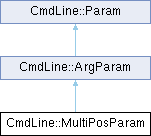
Classes | |
| struct | Definition |
| This definition is used to construct a MutiPosParam. More... | |
Public Types | |
| enum class | ParsingOrder { End , AfterOptions } |
| Determines the MultiPosParam parsing order. More... | |
Public Member Functions | |
| MultiPosParam (Definition d) | |
| Constructs a new MultiPosParam. | |
| std::string | Name () const override |
| Gets the name of the Param. | |
| std::string | Description () const override |
| Gets the description of the Param. | |
| std::string | HelpInfo () const override |
| Gets help information for the Param. | |
| bool | IsSpecified () const override |
| Indicates whether the MultiPosParam has been specified. | |
| bool | IsMandatory () const override |
| Indicates whether the Param is mandatory. | |
| bool | Populate (std::deque< std::string > &args) override |
| Populates the MultiPosParam from an argument queue. | |
| bool | CanPopulate (const std::deque< std::string > &args) const override |
| Determines if the specified args can populate the ArgParam. | |
| std::size_t | Consumes (const std::deque< std::string > &args) const override |
| Gets the number of arguments the MultiPosParam consumes. | |
| std::vector< std::string > | Values () const |
| Gets the values the MultiPosParam has been populated with. | |
| ParsingOrder | Order () const |
| Gets the ParsingOrder of the MultiPosParam. | |
| Public Member Functions inherited from CmdLine::ArgParam | |
| virtual | ~ArgParam ()=default |
| Destructs an ArgParam. | |
| Public Member Functions inherited from CmdLine::Param | |
| virtual | ~Param ()=default |
| Destructs a Param. | |
Detailed Description
A multi-value PosParam.
A MultiPosParam is a multi-value PosParam that is populated by multiple command line arguments rather than a single argument. MultiPosParam arguments are parsed by the command line Parser either immediately after the last Option is parsed or after the last single-value PosParam is parsed, depending on what MultiPosParam::ParsingOrder the MultiPosParam was created with. A MultiPosParam consumes a variable number of arguments based on how many arguments are left in the parser internal argument queue. Each argument consumed adds a single value to the values of the MultiPosParam. For example, a program that copies files might accept mutiple source file arguments and a single destination path argument. In this case, the program would use a MultiPosParam to capture the source files.
- Invariant
- Values can only be added upon successful population.
Member Enumeration Documentation
◆ ParsingOrder
|
strong |
Determines the MultiPosParam parsing order.
The command line Parser will examine the parsing order of the MultiPosParam to determine when it should be parsed.
| Enumerator | |
|---|---|
| End | Parse the MultiPosParam at the very end. Instructs the command line Parser to parse the MultiPosParam at the end, after the last single-value PosParam has been parsed. This is the default value. |
| AfterOptions | Parse the MultiPosParam after the last Option. Instructs the command line Parser to parse the MultiPosParam immediately after the last Option has been parsed but before the first single-value PosParam. |
Constructor & Destructor Documentation
◆ MultiPosParam()
| CmdLine::MultiPosParam::MultiPosParam | ( | Definition | d | ) |
Constructs a new MultiPosParam.
- Parameters
-
d The Definition used to create the MultiPosParam.
- Exceptions
-
Param::InvalidDefinition Doesn't satisfy invariants.
Member Function Documentation
◆ CanPopulate()
|
overridevirtual |
Determines if the specified args can populate the ArgParam.
Accepts a reference to an argument queue (deque) and determines if the next n arguments in the queue can populate the ArgParam.
- Parameters
-
args The argument queue to evaluate.
- Returns
- True if the arguments can populate, otherwise false.
Implements CmdLine::ArgParam.
◆ Consumes()
|
overridevirtual |
Gets the number of arguments the MultiPosParam consumes.
Each MultiPosParam consumes a certain number of arguments from an argument queue upon successful population. The number of arguments the MultiPosParam consumes is equal to the number of non-option arguments remaining in the queue.
- Parameters
-
args The argument queue to evaluate.
- Returns
- The number of arguments the MultiPosParam will consume.
Implements CmdLine::ArgParam.
◆ Description()
|
inlineoverridevirtual |
Gets the description of the Param.
The description of the Param is used for generating help.
- Returns
- The description of the Param.
Implements CmdLine::Param.
◆ HelpInfo()
|
overridevirtual |
Gets help information for the Param.
The help info will include the Name() and Description() of the parameter when generating help.
- Returns
- Help information for the parameter.
Implements CmdLine::Param.
◆ IsMandatory()
|
inlineoverridevirtual |
Indicates whether the Param is mandatory.
The command line Parser uses this to determine if a parameter must be specified at the command line for parsing to be successful. If a mandatory parameter is not specified, parsing will fail indicating the program was supplied with bad command line arguments.
- Returns
- True if the parameter is mandatory, otherwise false.
Implements CmdLine::Param.
◆ IsSpecified()
|
inlineoverridevirtual |
Indicates whether the MultiPosParam has been specified.
A MultiPosParam will only indicate it is specified if it has been successfully populated by command line arguments. The MultiPosParam must be populated by at least one argument to be specified. The command line Parser also uses this to determine if a mandatory MultiPosParam has been specified.
- Returns
- True if the MultiPosParam is specified, otherwise false.
Implements CmdLine::Param.
◆ Name()
|
inlineoverridevirtual |
Gets the name of the Param.
The name of the Param is used for generating usage and help.
- Returns
- The name of the Param.
Implements CmdLine::Param.
◆ Order()
|
inline |
Gets the ParsingOrder of the MultiPosParam.
The ParsingOrder determines whether a command line MultiPosParam is parsed imediately after the the last Option or at the end when the last single-value PosParam has been parsed.
- Returns
- The ParsingOrder of the MultiPosParam.
◆ Populate()
|
overridevirtual |
Populates the MultiPosParam from an argument queue.
Accepts a reference to an argument queue (deque) and attempts to populate the MultiPosParam from the remaining arguments in the queue. Populating the MultiPosParam marks it as specified and populates it with values from the command line arguments. Successful population also consumes the remaining arguments in the queue.
- Parameters
-
args The arguments to populate the MultiPosParam.
- Returns
- True if population is successful, otherwise false.
- Precondition
- Size of arguments > 0.
- All arguments are non-options.
- Postcondition
- The MultiPosParam is marked specified.
- The argument queue, arguments, is emtpied.
- Consumed arguments are added to the MultiPosParam values.
Implements CmdLine::ArgParam.
◆ Values()
|
inline |
Gets the values the MultiPosParam has been populated with.
With MultiPosParams, each value corresponds to exactly one command line argument and is populated in the order (position) of each argument.
- Returns
- The values the MultiPosParam was populated with.
The documentation for this class was generated from the following file:
- include/MultiPosParam.h